Program Management Platform vs Spreadsheets: Which One Scales Better for Innovation Programs?
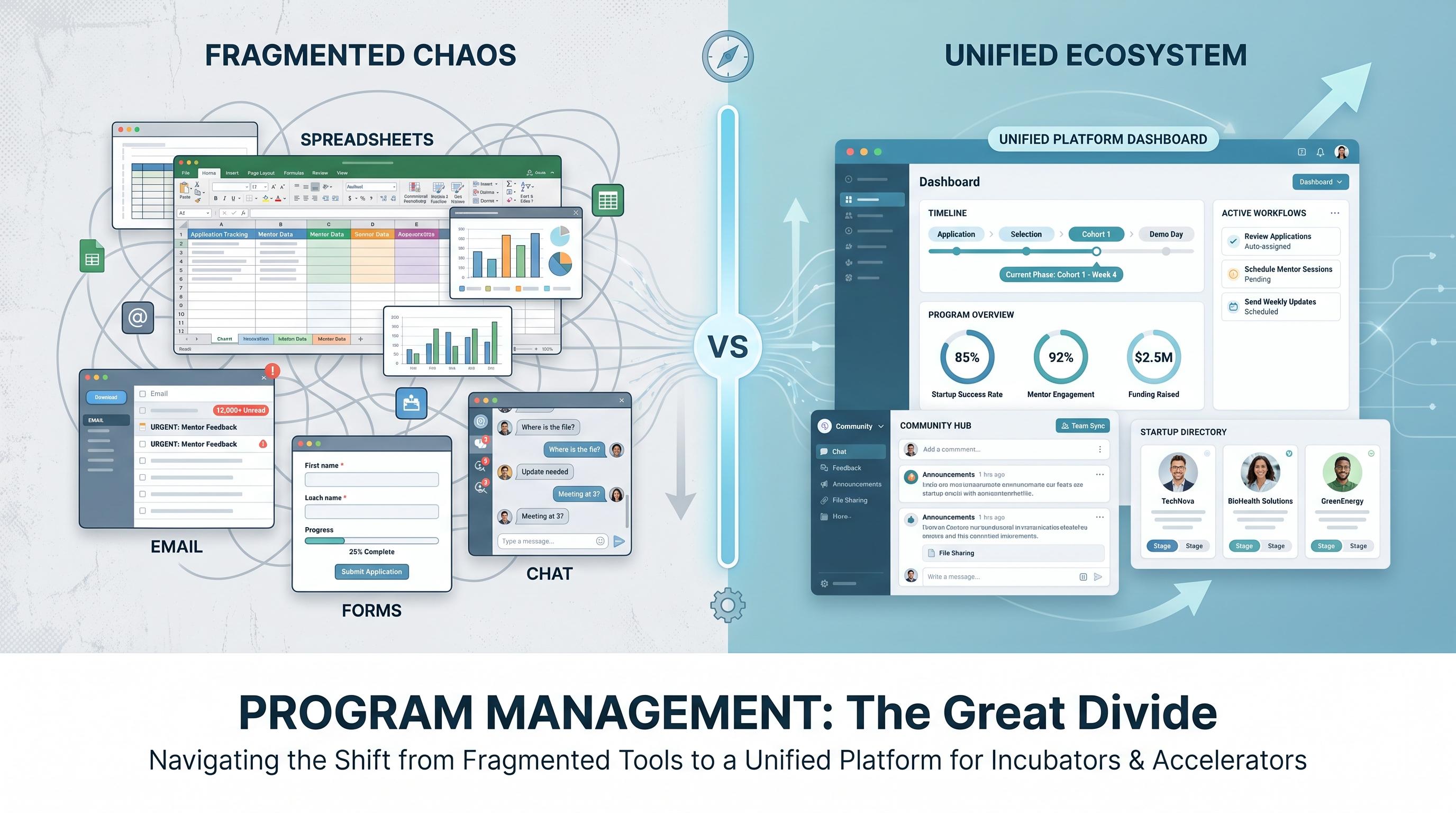
The short answer: a dedicated program management platform scales better once your program has volume, multiple stakeholders, and reporting pressure.
Spreadsheets and point tools can work for a small pilot, but they start breaking down when applications increase, review stages multiply, mentors need coordination, and leadership expects faster reporting. A dedicated program management platform is usually the better choice for incubators, accelerators, corporate innovation teams, and public-sector programs that need structure without operational chaos.
The comparison matters because most teams do not fail from lack of effort. They fail because core workflows are spread across forms, sheets, email threads, chat groups, shared folders, and manual follow-ups. That setup may feel flexible at first, but it becomes expensive in time, consistency, and visibility.
What are you really comparing?
You are not just comparing software categories. You are comparing two operating models for running programs.
Model 1: Spreadsheets and point tools. Applications sit in one tool, evaluations in another, mentor coordination in email, progress tracking in shared files, and reporting in manually prepared summaries.
Model 2: A dedicated program management platform. Applications, reviews, cohorts, stakeholders, milestones, and reporting work inside one connected system with shared visibility.
For program teams, the second model reduces handoffs. For leadership, it improves trust in the numbers. For founders and mentors, it creates a more consistent experience.
Program management platform vs spreadsheets: side-by-side comparison
A dedicated program management platform wins on coordination, consistency, and scale. Spreadsheets still win on simplicity for very early-stage or low-volume programs.
Area | Spreadsheets and point tools | Program management platform |
|---|---|---|
Application intake | Manual imports, duplicate copies, version confusion | Centralized forms, stage tracking, cleaner intake flow |
Evaluation workflow | Reviewer feedback scattered across files and messages | Structured scoring, comments, and decision visibility |
Cohort management | Static lists, harder to maintain context over time | Live startup profiles, stage movement, shared records |
Mentor coordination | Depends on memory and email follow-up | Trackable relationships, clearer matching and follow-through |
Milestone tracking | Inconsistent templates, manual reminders | Standardized updates and better progress visibility |
Reporting | Manual compilation each cycle or quarter | Faster dashboards and more reliable stakeholder reporting |
Audit readiness | Hard to reconstruct decisions and changes | Stronger process visibility and accountability |
Scale | Works for small pilots | Better for growing or multi-stakeholder programs |
When spreadsheets still make sense
Spreadsheets make sense when the program is small, the number of applicants is low, and the workflow is simple. If you are testing a new initiative with one operator, a short cycle, and limited reporting expectations, a lightweight stack can be enough for a while.
That said, spreadsheets stop being efficient earlier than most teams expect. Once your team is spending more time reconciling information than improving program quality, the cost of staying with fragmented tools starts exceeding the cost of moving to a dedicated platform.
When a dedicated platform becomes the better choice
A dedicated platform becomes the better choice when complexity becomes normal rather than occasional. If your team runs multiple cohorts, manages external evaluators, coordinates mentors, tracks startup progress, or reports to multiple stakeholders, the operating model needs to mature.
You review a high volume of applications every cycle.
You need stage-based screening, scoring, and decision trails.
You run mentor, jury, founder, partner, or alumni workflows in parallel.
You prepare recurring reports for leadership, funders, or government stakeholders.
You are expanding into multi-program, hub-and-spoke, or multi-location operations.
These are not edge cases. They are signs that the program has outgrown a patchwork setup.
How the choice affects program managers day to day
For program managers, the biggest difference is operational drag. In a fragmented setup, the team spends hours chasing updates, reformatting inputs, reminding reviewers, aligning mentor schedules, and rebuilding the same status view for different audiences.
In a connected platform, the workflow becomes easier to run because the system carries more of the coordination load. Applications move through visible stages. Evaluator comments stay attached to the right startup. Progress updates follow a consistent structure. Reporting takes less assembly work because the information is already connected.
This is why the platform decision is not only an IT decision. It is a delivery decision. It shapes how smoothly the program runs for everyone involved.
How the choice affects leadership and governance
Leadership usually feels the pain at reporting time. A spreadsheet-driven process makes every update dependent on manual consolidation, which slows down reviews and weakens confidence in the numbers.
A dedicated program management platform improves governance because decisions, milestones, and stakeholder activity are easier to trace. That matters even more for university programs, corporate innovation initiatives, grant-backed accelerators, and public-sector ecosystems where transparency and accountability are part of the mandate.
For teams with compliance or structured governance needs, this is often the tipping point. The question changes from “Can we keep using what we have?” to “Can we keep defending how we operate?”
What to look for in a program management platform
The best program management platform is the one that matches how innovation programs actually operate. It should reduce admin work while improving visibility for operators, leadership, mentors, and founders.
Configurable workflows for applications, screening, and cohort stages
Role-based access for internal teams, evaluators, mentors, and partners
Startup profiles that keep progress, documents, and interactions in one place
Milestone tracking and structured founder reporting
Clear dashboards for operational and leadership reporting
Support for ecosystem models such as incubators, accelerators, corporates, universities, and government programs
If you are comparing options, it is also useful to look at how clearly the platform supports your real workflows, not just how long the feature list is. A system that fits your operating model will outperform a generic tool stack that needs constant manual workarounds.
Where SanchiAPP fits in this comparison
SanchiAPP is designed for organizations that need more than basic task tracking. It is built for innovation ecosystems that manage applications, evaluations, stakeholders, reporting, and everyday program operations in one place.
That makes it a stronger fit for incubators, accelerators, government-backed initiatives, corporates, and venture studios that need connected workflows rather than a loose collection of tools. Teams comparing operational approaches can review the features overview, explore the pricing plans, or read this guide on replacing fragmented program operations for a deeper look at the shift from manual coordination to a unified system.
Final takeaway
If your program is still small and simple, spreadsheets may be enough for now. If your team is managing scale, stakeholders, recurring reporting, and founder experience at the same time, a dedicated program management platform is the stronger long-term choice.
The real question is not whether a platform has more features. It is whether your current setup helps the team run programs with speed, consistency, and confidence. Once the answer becomes no, the comparison is over.
FAQ
A program management platform is a system that helps teams run core workflows such as applications, reviews, cohorts, mentors, milestones, stakeholder coordination, and reporting. It gives operators and leadership one connected place to manage the full program lifecycle.
For small pilots, spreadsheets can be enough. For growing programs with multiple stakeholders and recurring reporting needs, a dedicated platform is usually better because it reduces manual coordination and improves visibility across the program.
A team should move beyond spreadsheets when application volume rises, review workflows become multi-stage, mentor coordination becomes hard to track, or reporting starts taking too long. Those are strong signs that the operating model is no longer scaling cleanly.
Compare how each option handles applications, evaluations, cohorts, stakeholder workflows, milestone tracking, reporting, and governance. The right choice is the one that best matches your actual operating model, not just the one with the broadest feature list.
SanchiAPP is an advanced productivity platform and ecosystem operating system built to power startup, MSME, innovation, incubation, acceleration, corporate, and government ecosystems at scale.